Electrocoagulation
Destabilizes suspended solids, oils, and colloids so they can separate from the stream.
 Save Water
ElectroX uses non-contact micro-electrolysis to
treat wastewater at
source, without chemical burden or
complex biology.
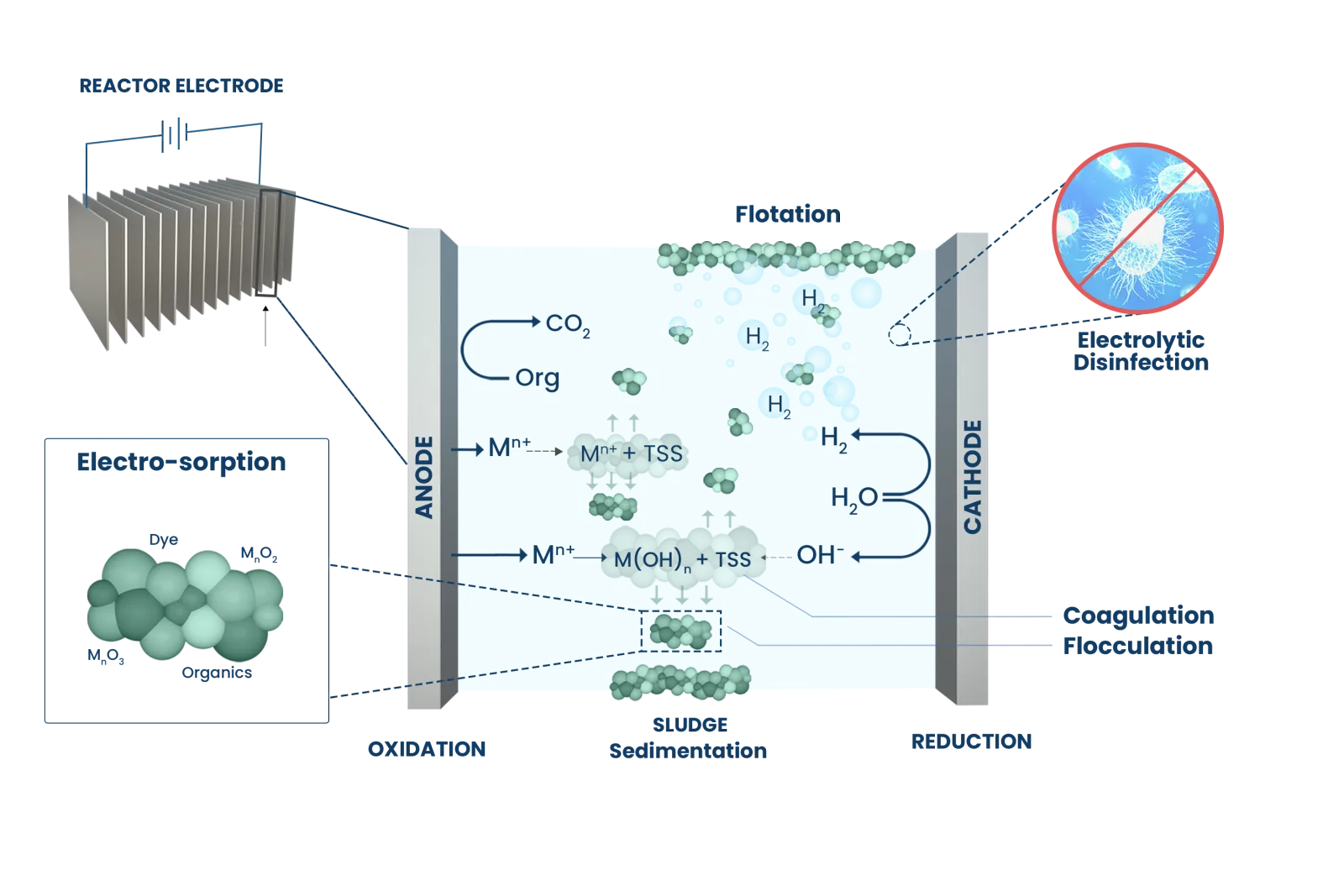
Destabilizes suspended solids, oils, and colloids so they can separate from the stream.
Uses gas micro-bubbles to lift separated material for removal without adding mechanical complexity.
Forms denser flocs that improve downstream separation and reduce dependence on dosing recipes.
Supports pathogen control as part of the electrical treatment route for reuse-focused systems.
Targets organics, dyes, COD load, and difficult constituents through oxidation pathways.
Helps capture selected ions and pollutants where the stream needs tighter polishing.
The reactor is tuned to pollutant chemistry, not a fixed chemical recipe. That is what lets Indra address varied streams without turning the plant into a stack of isolated treatment steps.
We integrate advanced nanotechnology with ElectroX to enhance adsorption, contaminant trapping, and reaction kinetics. This supports stronger contaminant removal, shorter reaction routes, and steadier overall process performance.
Our process is designed to drive multiple treatment reactions in parallel rather than in sequence. This supports simultaneous treatment of key pollutants such as COD and hardness, reducing process steps and simplifying system design where the stream chemistry allows it.
We develop specific treatment pathways for challenging contaminants such as ammonia, brine, and recalcitrant compounds. By aligning treatment strategy with pollutant chemistry, the system can be tuned for steadier performance across diverse industrial wastewater streams.
Indra applies preferential treatment mechanisms based on the nature of each pollutant, using adsorption, physical trapping, or electro-oxidation as required. This targeted approach helps match energy and material use to the treatment job instead of forcing every stream through the same recipe.
The comparison focuses on operational differences: chemical dependency, plant sprawl, and control over reuse quality.
We fit into any treatment train,
wherever
you need us.
Used before downstream systems when the incoming stream needs load reduction, shock-load handling, or targeted removal of silica, hardness, sulphates, VOCs, and similar contaminants.
Used as the main treatment step when electrical reactions can simplify the route, reduce chemical dependency, and bring variable industrial or non-industrial wastewater under control.
Used after existing systems when a site needs tighter treated-water quality, including support for heavy metals, fluoride, bromide, and other polishing challenges.
Every litre matters. Whether you're a hotel managing sewage, a steel plant cutting freshwater intake, or a township building circular water systems - we're ready.
Connect with Indra